Horse fencing in Mildura and on lifestyle blocks
Horse fencing in Mildura and the towns around it is a different job from a sheep paddock. Some wire that suits cattle is not advised for horses, so the choice of wire, mesh or rail, and whether to add an electric line, comes first. This page sets out what the sources we could read say about horse paddocks and rural-residential blocks, where they stop, and the rules to check on each side of the Murray. Your enquiry is passed to a local contractor, who does the work and is responsible for holding any licence or registration that applies.
We found no Australian horse fencing guide and no Australian standard for horse fencing, so the points below come from a secondary source and a supplier handbook. Treat them as questions to put to a contractor, not as a specification.
Why lifestyle blocks around Red Cliffs and Irymple
At the 2021 Census separate houses made up 93.3 per cent of occupied dwellings in Irymple and 92.1 per cent in Red Cliffs. That fits a district of houses on larger blocks, which is where horse paddocks and small acreage fencing come from, but it is an inference only. The census pages give no lot sizes and no count of rural-residential blocks, so this site does not claim how many there are. Local detail is on the Red Cliffs and Irymple page and the Mildura urban fringe page.
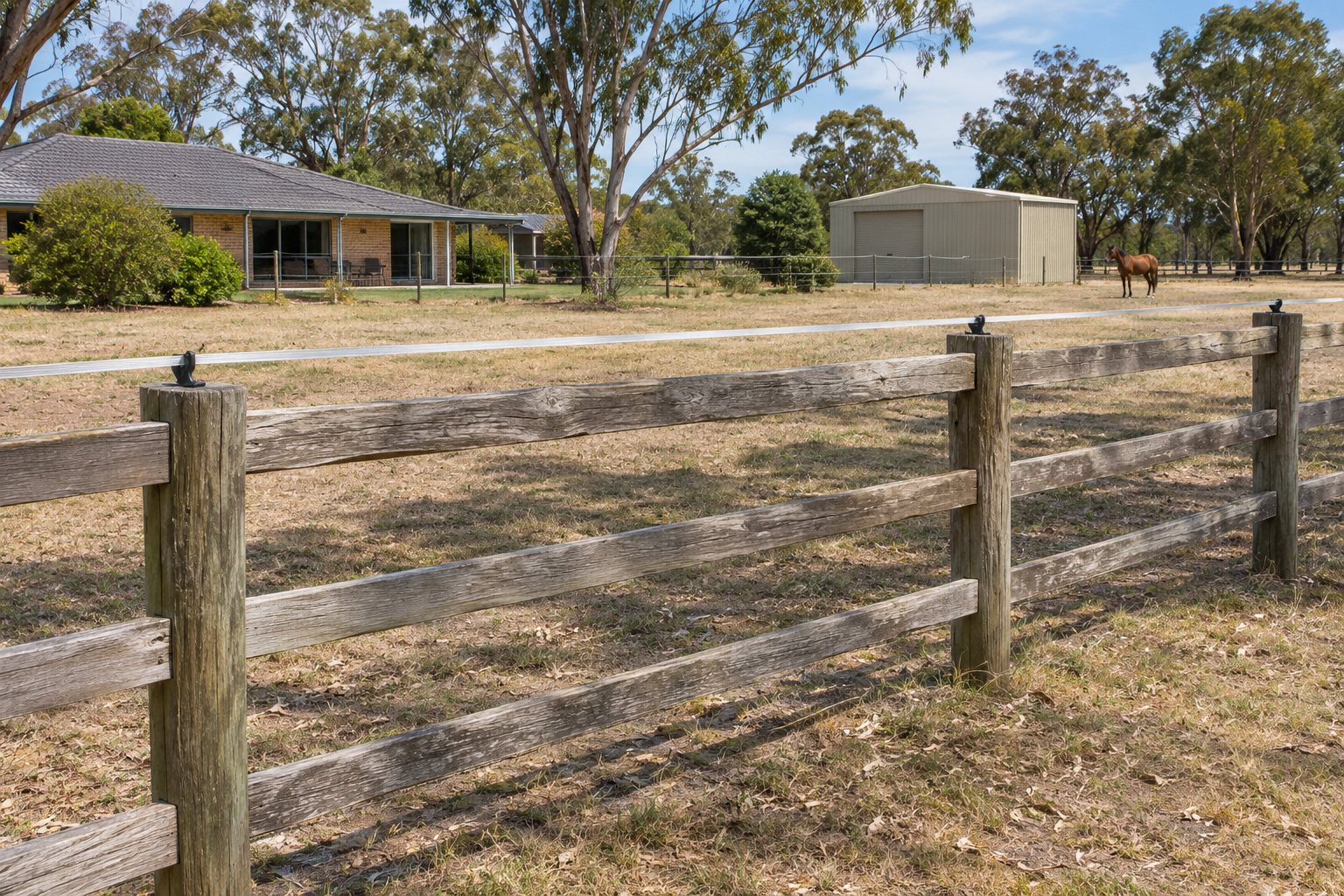
Wire, mesh, rail and electric: what the sources say
A secondary source (an encyclopedia article on agricultural fencing) is the main one for horses. It is general, not local, and not an Australian standard.
| Fence type | What the source says | Ask the contractor |
|---|---|---|
| Barbed wire | Mild steel barbed wire "is not advised for horses". | Whether any barbed wire is proposed anywhere near the horses, and why. |
| Woven wire "field fence" | Large openings can trap hooves, so horses are better behind small-opening "no climb" mesh. | The opening size of the mesh, and what height. |
| Smooth wire | Used for horses, often with an electric line. | Whether it is plain wire, and how it is strained. |
| Rail | Used where cost matters less, such as horse farms. | Rail material, post spacing and how the rails are fixed. |
Do not electrify barbed wire (supplier fencing handbook). If the fence has an electric line, the energiser, the insulators and the earthing matter, and dry sandy soil changes the earthing. The electric fence guide covers the parts and the soil.
On the New South Wales side of the Murray, a statewide fact sheet says electric fencing in rural zones must be constructed in accordance with AS/NZS 3014:2003 (NSW exempt fence fact sheet). We could not verify the current status of that standard, so ask the council. On the New South Wales side of the Murray, the NSW Planning Portal also says electric fencing and barbed wire are banned in residential, business and industrial zones, except R5 (Planning Portal fences page). On the Victorian side of the Murray we found no equivalent, so ask Mildura Rural City Council.
Permits and the council
On the Victorian side of the Murray, Mildura Rural City Council lists fences among building types that may need a permit and tells you to check with its building department on 03 5018 8100 (Mildura Rural City Council). We did not find Mildura's own height threshold. Another Victorian council says a permit applies where a fence is more than 2 m high, but that is another Victorian council's rule, quoted only as an illustration of how such a rule is written (another council's page). It is not Mildura's.
For New South Wales, a statewide exempt development fact sheet (the January 2022 copy we found, so check the current version) says that in rural and environment protection zones fences must not be higher than 1.8 m, must be post and wire or post and rail, can be masonry only within 3 m either side of the entrance, and on bushfire-prone land must be non-combustible or hardwood. It is a statewide document and does not mention Wentworth Shire, so ask Wentworth Shire Council how it applies to a block on the New South Wales side of the Murray.
Boundaries, neighbours and pool barriers
A lifestyle block usually has neighbours close by. On the Victorian side of the Murray, Justice Victoria says costs are shared equally in the normal case and the neighbour has 30 days to respond to a Fencing Notice (Justice Victoria). On the New South Wales side of the Murray, the notice must be served at least one month before an application. The Victorian page and the New South Wales page keep the two apart.
A fence that is also a pool barrier is a separate regulated fence. On the Victorian side of the Murray, Justice Victoria says it is the pool owner's cost (Justice Victoria). On the New South Wales side of the Murray, Legal Aid NSW says the same (Legal Aid NSW FAQ). Ask the council about pool-barrier requirements before you design the fence.
Safety and what to ask
A university procedure (safe operating procedure) lists hazards for anyone building a fence: use a post holder rather than hands, keep people clear of the swing path of manual drivers, watch tractor stability, and expect recoil and cuts from high-tensile and barbed wire. It also says to consult the electricity company before working near overhead lines and to call dial before you dig, 1100, before digging post holes. It is not a regulator, and this page gives no safety instruction beyond pointing to it.
Ask the contractor which licence or registration they hold and check it with the regulator for the side of the Murray where the fence is, because the regulator pages we found do not say whether horse or lifestyle fencing needs one. The licensing page has the detail, and the cost guide lists what a written quote should itemise. Stock fencing is on the farm and stock page.
What this page cannot do
It cannot design a horse fence, because we found no Australian horse fencing guide and no Australian standard, and the points above come from a secondary source and a supplier handbook. It cannot say how many lifestyle blocks there are, because the census pages give no lot sizes. It cannot give a price, say what licence or registration a contractor needs, or approve a permit. Ask the contractor what they would build for your horses and why, ask the council what applies on your block, and ask the regulator about licensing.
Check the current rules before you rely on this
This page describes the wire, mesh, rail and electric options the sources give for horse paddocks and rural-residential blocks and the permit and boundary points on each side of the Murray. It describes the rules in general terms as they stood in November 2026. Standards, forms, thresholds and fines change.
The authoritative sources are Wikipedia, agricultural fencing (secondary source), Rural supplier's fencing handbook (undated; supplier guide, no heights, spacings or costs), Mildura Rural City Council, building permits, Justice Victoria, fences: your rights and obligations and Wentworth Shire Council, fences: rules for exempt and complying development (NSW fact sheet, January 2022, statewide). Where anything here differs from those sources, they are right and we are not.
We are not fencing contractors, builders, regulators or lawyers. For what applies to your fence, ask the contractor which licence or registration they hold, then ask the regulator for the side of the Murray where the fence is: Building Commission NSW (13 27 00) for New South Wales, the Building and Plumbing Commission for Victoria.
Accurate at the time of writing, November 2026. Always check the source before relying on it.