What moves the cost of rural fencing in Mildura
A rural fencing quote is built from a short list of things: the kind of fence, how long and hard the line is to build, the ground, the number of ends, corners and gates, who else has to agree, and which approvals apply. This guide sets them out so you can compare two written quotes line by line. It does not name a cost per metre, because that means little until the line, the ground and the ends are known.
The rules about neighbours and paperwork differ on the two sides of the Murray, so each one below says which side it applies to.
| Factor | How it moves a quote | What to tell the contractor |
|---|---|---|
| Fence type | The general material we read describes wire mesh as cheaper but possibly needing earlier repair, horse paddock fencing as costing more than basic cattle fencing, and an electric wire added to stock fencing as a way to reduce cost. Treat these as general, not rules. | What the fence must hold: sheep, cattle, horses, rabbits or kangaroos |
| Length and terrain | Difficult ground with limited machinery access needs more manual labour and time. | Rough length, slope, scrub and gullies |
| Access and delivery | Transport and delivery are part of the job, and hard access adds to them. | Gate positions, tracks and whether a truck can reach the line |
| Ground | The soil survey describes sand, hard-setting soil and limestone layers, but not digging, so ask whether the quote allows for drilling. See the hard ground guide. | Any rock, sand or earlier trouble with digging on the block |
| Ends, corners and gates | Each end assembly adds posts, stays and labour, and gateways, corners and changes of direction are where they go (one supplier's fencing handbook). | Where the corners, gateways and direction changes fall |
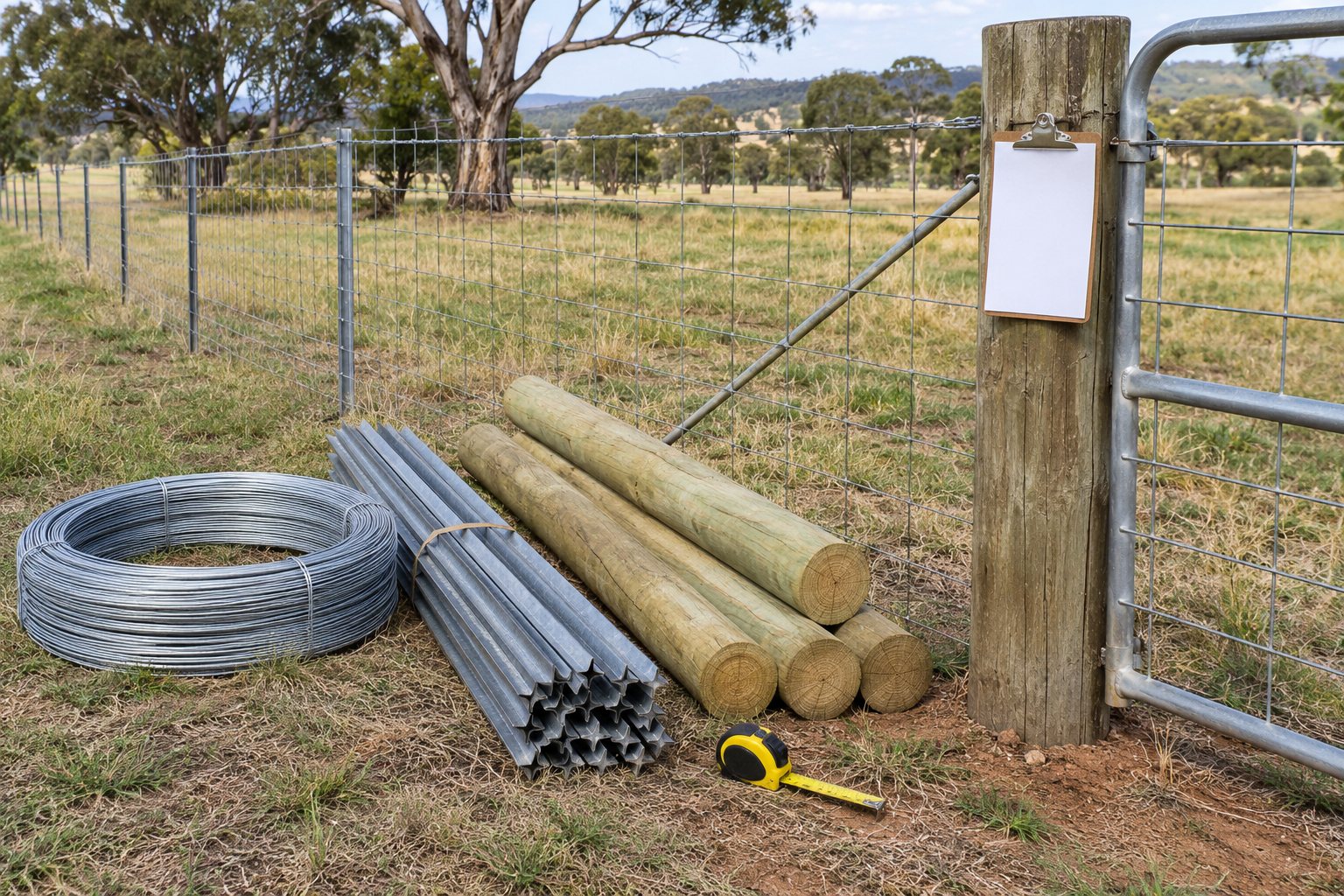
| Posts and wire | Post type and treatment or galvanising, and wire type and gauge, are separate choices. | Whether you have a preference |
| Exclusion fencing | One Victorian council's fact sheet says large exclusion fences cost more, consolidated fences are more cost-effective than long hard-to-see enclosures, and skirts are costly to remove. | Which animal, and whether a buried or laid-flat skirt is wanted |
| Approvals | A planning permit in a flood overlay, a building permit for a tall fence or vegetation clearing can add time, fees or both. | Whether the line is near the river, a channel or a flood area |
| Boundary or internal | On a boundary the cost is normally shared with the neighbour first. See below. | Who the neighbour is: a private owner, Crown land, a council reserve or a water authority |
| Fire and heat timing | Grinding and welding in the open are restricted on Total Fire Ban days in the Victorian sources we found, which can move dates. | Your preferred dates |
The factors are not equal. On a long dryland boundary, length and the number of ends may decide it; on a small horse paddock, the fence type and gates may matter more. If one quote is far from another, start with this table, not the total. How long a fence lasts is a separate question: see how long a rural fence lasts.
Ground, access and the Sunraysia block
Ground sets a Mildura-area job apart. The Victorian soil survey for the Mallee describes soils from sands to clays, and in stony soils a solid limestone layer within 30 cm of the surface (Mallee Calcarosols). That page does not discuss digging or posts, so ask the contractor whether the quote allows for drilling and how rock is charged. Dry sandy soil also changes how an electric fence is earthed, which can add parts and labour: see the electric fence guide.
Boundary fences: who pays, and what the share can cover
If the fence is on a boundary, the first question is not the contractor's price but the split with your neighbour. On the Victorian side of the Murray, Justice Victoria says costs are shared equally in the normal case, that a neighbour who wants a higher standard pays the difference, and that the shared costs can include design, clearing land, removing the old fence, surveying, approvals and temporary barriers. A Fencing Notice starts a 30 day response period on the Victorian side of the Murray. See the Victorian boundary fence page.
On the New South Wales side of the Murray, Legal Aid NSW says neighbours generally share the cost of a sufficient dividing fence, and the notice period before either neighbour can go further is one month. See the New South Wales boundary fence page. Ask the contractor to quote the fence, not the split, which is between you and your neighbour.
Approvals that add time or cost
On the Victorian side of the Murray, flood overlays can need a council planning permit for fences, and Mildura Rural City Council lists fences among building types that may need a building permit: ask its building department on 03 5018 8100 (Mildura building permits). On the New South Wales side of the Murray, a statewide fact sheet sets exempt development limits for rural fences. The Murray page sets out both sides, including vegetation clearing. A permit is about the fence, and is not the same as a licence or registration.
What a written quote should itemise
Ask for the quote in writing and ask whether it covers each of these.
- Fence length and line. Who locates the line, and whether a survey is included.
- End assemblies and gates. How many, and of what type.
- Post type and treatment or galvanising.
- Wire type and gauge.
- Straining and tying off. Whether wire is strained to the manufacturer's tension.
- Rock drilling. Whether it is allowed for, and how rock found on the day is charged.
- Vegetation clearing. What is cleared, by whom, and any approval.
- Permits. Flood overlay, building or vegetation, and who applies.
- Removal of the old fence. Included, extra, or left for you.
- Electric parts and earthing. If the fence is electric.
- The licence or registration held. Which one, and for which side of the Murray.
- Who serves any neighbour notice. It is between you and your neighbour, so settle who prepares it.
Licence checks, contracts and deposits
Ask which licence or registration the contractor holds, and check it with the regulator for the side of the Murray where the fence is. The regulator pages we found do not say whether farm, stock, vineyard or exclusion fencing needs one, so this site does not say either. The licensing page sets out what they do say.
On the New South Wales side of the Murray, the NSW Government's contracts page (building contracts) says a written contract is required over $5,000 including GST, that residential building work from $5,000 to $20,000 needs a small jobs contract, that work over $20,000 needs an extensive contract and a Home Building Compensation certificate, and that the maximum deposit is 10 per cent. Those are stated if the work counts as residential building work (the pages do not say whether a rural fence does), and the page does not mention fencing.
Site checks before anyone digs
A university safe operating procedure for fencing (University of New England procedure), not a regulator's rule, says to call Dial Before You Dig on 1100 before digging strainer post holes and to consult the electricity company before working near overhead lines. Ask the contractor how they handle both, and how fire and heat restrictions affect timing: the seasons guide has the Victorian Total Fire Ban points.
Stock jobs are covered on the farm and stock fencing page. When you are ready, send the town, the side of the Murray and a photo of the line.
What this checklist cannot do
A checklist cannot tell you what your fence will cost or which fence type is right for your land. We are a referral service: we pass your enquiry to local contractors, who set their own terms, and we do not quote, build or sign contracts. The factors above show what to ask, not what to expect.
Check the current rules before you rely on this
This page describes the factors that move a rural fencing quote around Mildura and Wentworth Shire and how to compare written quotes. It describes the rules in general terms as they stood in November 2026. Standards, forms, thresholds and fines change.
The authoritative sources are Justice Victoria, fences: your rights and obligations, Legal Aid NSW, fences: your rights and obligations, NSW Government, building contracts and home building compensation, NSW Government, fencing work (Building Commission NSW), Consumer Affairs Victoria, becoming a registered building practitioner and University of New England, safe operating procedure 09: fencing (28 March 2018; a university procedure, not a regulator). Where anything here differs from those sources, they are right and we are not.
We are not fencing contractors, builders, regulators or lawyers. For what applies to your fence, ask the contractor which licence or registration they hold, then ask the regulator for the side of the Murray where the fence is: Building Commission NSW (13 27 00) for New South Wales, the Building and Plumbing Commission for Victoria.
Accurate at the time of writing, November 2026. Always check the source before relying on it.